Mana Pool

Mana Pool integration

TCG Sync's Mana Pool connector syncs your inventory to Mana Pool, keeping stock and pricing aligned across every channel. Mana Pool is a growing Magic: The Gathering marketplace, so for most shops it is an additional outlet for singles rather than a replacement for an existing channel. The value is in not running it manually: your TCG Sync catalogue supplies the listings, sales decrement the same stock record as the counter and your storefront, and orders land in the same queue your staff already pick from. Adding a channel should not add a second inventory to reconcile at the end of the week.

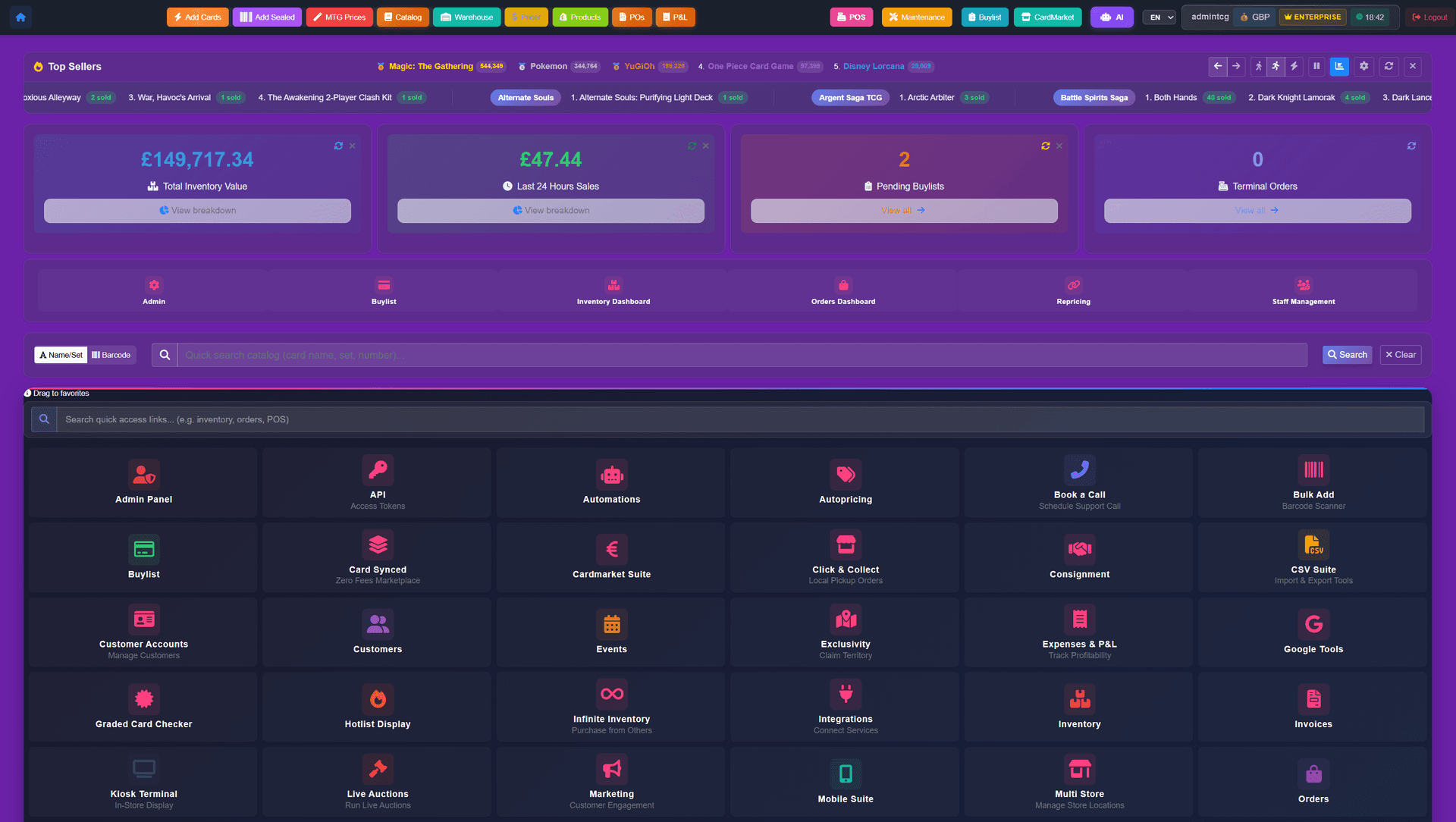
TCG Sync admin dashboard showing operational data and connected marketplace workflows.
TCG Sync admin dashboard. Marketplace connectors feed into the same inventory, order, and exception-handling workflow.
Technical spec

Mana Pool sync — how it works

The concrete details of the TCG Sync ↔ Mana Pool integration. Updates sync via webhooks, usually within seconds — allow up to 15 minutes.

Integration
Mana Pool seller integration
Sync speed
Webhooks — usually seconds, up to 15 min
Conditions supported
Full Mana Pool condition ladder
Catalogue focus
Magic: The Gathering singles
Stock source
Your TCG Sync inventory, kept in sync with Shopify
Capabilities

What the integration does

Concrete features, not marketing bullets.

  • Full inventory sync from your central catalogue
  • Automated stock updates as cards sell on other channels
  • Orders flow into the unified pick, pack, and dispatch queue
  • Channel pricing rules specific to Mana Pool
  • Condition-aware listings rather than a single flattened entry
  • Mana Pool sales reconciled into your overall sales reporting
Operations

How Mana Pool fits into one inventory source

Marketplace sync is only useful if staff can trust the numbers at the counter. TCG Sync treats each channel as an output of the same stock ledger, not as a separate spreadsheet to reconcile later.

One stock ledger

Storefront, POS, buylist, and connected marketplace listings all draw from the same inventory record. When a card sells on one connected channel, its quantity is updated on the others via webhooks, instead of waiting for staff to remember a manual update.

Channel-specific rules

Your own storefront can hold margin while marketplace listings compete more aggressively. Pricing rules can reflect fees, shipping expectations, condition, language, and how quickly you want a particular catalogue to move.

Order reconciliation

Orders from connected channels are pulled into the same fulfilment queue as online and in-store sales. Staff pick, pack, refund, and report from one place instead of switching between seller portals.

Exception handling

API limits, rejected listings, missing SKUs, and price-rule conflicts are visible in the admin dashboard. The integration is designed to make failures obvious, because silent sync failures are how oversells happen.

Limitations

What it doesn't do

We'd rather tell you the limits before you start than have you discover them after onboarding.

  • Requires a Mana Pool seller account
  • Magic-focused, so it will not carry your Pokemon or Yu-Gi-Oh! stock
  • Mana Pool sets its own payout timing
FAQ

Frequently asked questions

Is Mana Pool supported alongside other marketplaces?
Yes. Mana Pool runs alongside CardNexus, Cardmarket, eBay, TCGplayer, and Cardtrader from one inventory, with Shopify as the source of truth and CardSynced supplying pricing data and supported listings.
Is the Mana Pool integration included in Storefront Pro?
Yes. Supported marketplace connectors are part of Enterprise (from $2,499 USD/month) and Storefront Pro ($1,000 USD setup + 2% of TCG singles and sealed sales). Connectors are not sold individually and there is no per-channel add-on.
Is Mana Pool worth adding if I already sell on CardNexus and eBay?
It depends on your Magic volume. Mana Pool is Magic-focused, so shops with deep singles stock tend to treat it as incremental reach rather than cannibalised sales. Because the listings come from inventory you already maintain, the ongoing work of running it is small.
What stops me overselling a card listed in several places?
One stock record feeds every channel. When a card sells on Mana Pool, at the counter, or on another marketplace, the quantity is updated on the other connected channels from that same record via webhooks, rather than waiting for a nightly file to catch up.
How quickly do Mana Pool listings reflect a price change?
Pricing rules push through the same webhook sync as stock, so a repricing run reaches Mana Pool without a separate export step. How fast the change appears in Mana Pool's own search results is controlled by Mana Pool.
Pricing

Mana Pool sync — included with onboarding

Supported channels are included with Enterprise and Storefront Pro, with no per-channel charge.

  • Percentage-based

    Storefront Pro

    $1,000USD one-time setup

    + 2% of TCG singles and sealed sales across POS, Shopify and marketplaces — comics, board games, accessories, drinks, toys and other non-TCG items are excluded

    Ask about Storefront Pro
  • Tailored package

    Custom

    Let’s discuss itScoped around your business

    Scope and pricing agreed together

    Let’s discuss it

All prices are in USD. Enterprise also includes dedicated support and direct access to the founders for feature requests. Every package includes the Storefront Pro storefront — use it, or keep your current front end and we'll work with that. On every package, support runs 24/7, 365 days a year, with replies within 24 hours; staff training is over Zoom, and you can book Zoom calls for extra help. Third-party payment processing and marketplace fees are separate. Every package starts with an email to omar@tcgsync.com — tell us about your store and integrations and we'll help you choose.