Cardtrader

Cardtrader integration

TCG Sync's Cardtrader connector syncs your inventory to Cardtrader's European marketplace through automated background sync. Conditions and language variants are tracked natively rather than flattened into a single listing, and orders flow back into the same dashboard as your storefront and counter sales. Cardtrader matters most to shops selling into mainland Europe, where buyers filter hard on language and condition, so a listing that says the wrong thing costs you the sale or earns a dispute. Stock comes from one central inventory, so when a card sells at the counter, the Cardtrader listing is updated without anyone rekeying stock.

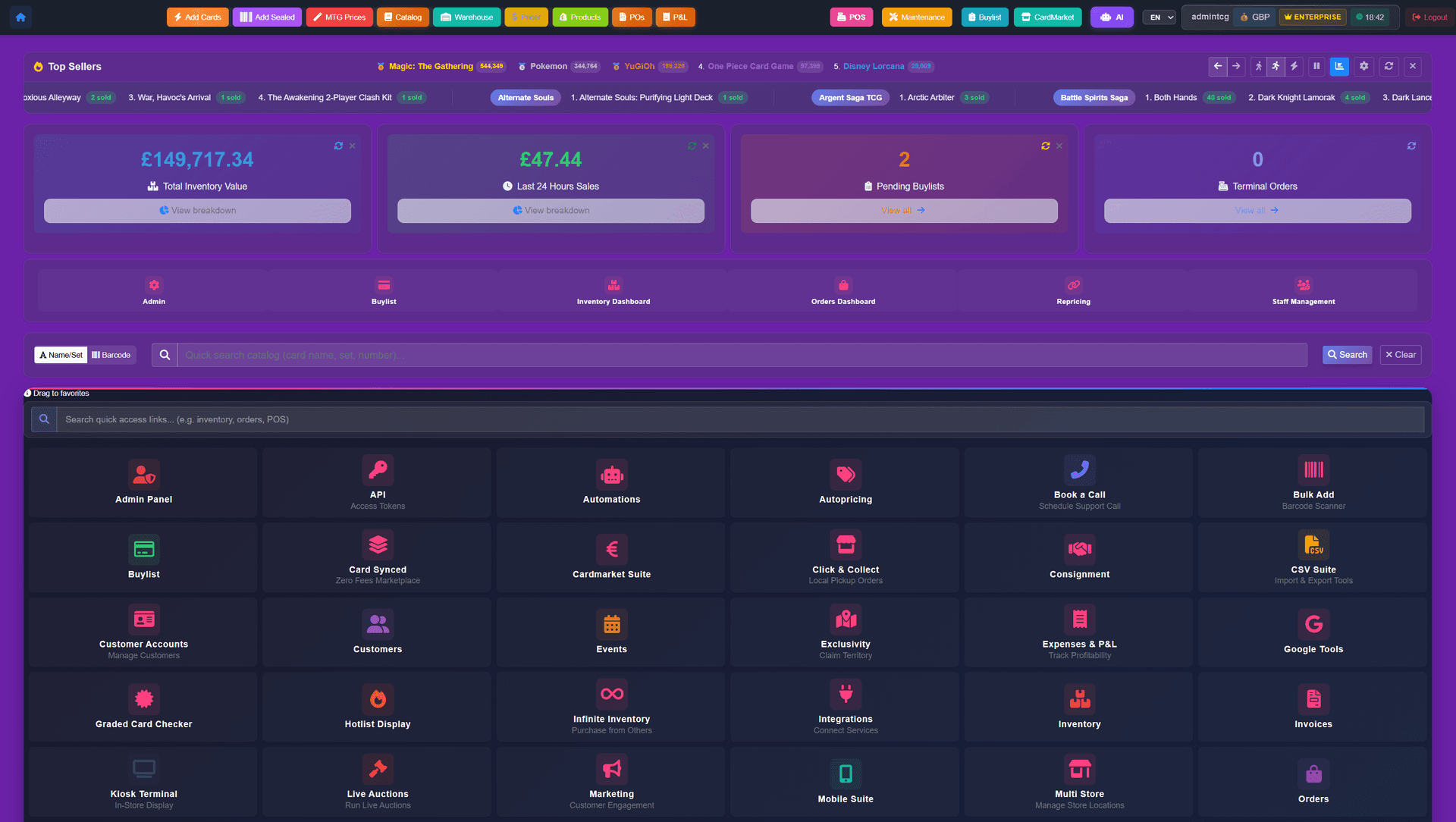
TCG Sync admin dashboard showing operational data and connected marketplace workflows.
TCG Sync admin dashboard. Marketplace connectors feed into the same inventory, order, and exception-handling workflow.
Technical spec

Cardtrader sync — how it works

The concrete details of the TCG Sync ↔ Cardtrader integration. Updates sync via webhooks, usually within seconds — allow up to 15 minutes.

Integration
Cardtrader API — your seller credentials
Sync speed
Webhooks — usually seconds, up to 15 min
Conditions supported
Full Cardtrader condition ladder
Languages
All Cardtrader-supported languages
Stock source
Your TCG Sync inventory, kept in sync with Shopify
Orders
Imported into the unified order pipeline
Capabilities

What the integration does

Concrete features, not marketing bullets.

  • Full inventory sync with conditions and languages
  • Automated stock updates across every sale
  • Orders flow into unified dashboard
  • Channel pricing rules per Cardtrader category
  • Language variants listed separately rather than merged
  • Central stock decrement so counter sales pull Cardtrader listings down
Operations

How Cardtrader fits into one inventory source

Marketplace sync is only useful if staff can trust the numbers at the counter. TCG Sync treats each channel as an output of the same stock ledger, not as a separate spreadsheet to reconcile later.

One stock ledger

Storefront, POS, buylist, and connected marketplace listings all draw from the same inventory record. When a card sells on one connected channel, its quantity is updated on the others via webhooks, instead of waiting for staff to remember a manual update.

Channel-specific rules

Your own storefront can hold margin while marketplace listings compete more aggressively. Pricing rules can reflect fees, shipping expectations, condition, language, and how quickly you want a particular catalogue to move.

Order reconciliation

Orders from connected channels are pulled into the same fulfilment queue as online and in-store sales. Staff pick, pack, refund, and report from one place instead of switching between seller portals.

Exception handling

API limits, rejected listings, missing SKUs, and price-rule conflicts are visible in the admin dashboard. The integration is designed to make failures obvious, because silent sync failures are how oversells happen.

Limitations

What it doesn't do

We'd rather tell you the limits before you start than have you discover them after onboarding.

  • Requires Cardtrader seller account with API access
  • Cardtrader's payout schedule is set by Cardtrader
  • Listing categories follow Cardtrader's taxonomy, not your storefront categories
FAQ

Frequently asked questions

Do I need a specific Cardtrader subscription for API access?
Cardtrader's API is available to active sellers on appropriate plans. Check your Cardtrader account or contact them for API access; once enabled, we connect via your credentials.
Is Cardtrader included in Storefront Pro?
Yes. Cardtrader is included with Enterprise and Storefront Pro at no extra connector cost.
How are language variants handled?
Separately. An Italian print and an English print of the same card are distinct listings with their own stock and pricing, which is how Cardtrader buyers expect to search. They still draw from one catalogue record in TCG Sync, so your stock count stays correct across both.
What happens when the same card sells in store first?
The Cardtrader listing is reduced from the same inventory record, so the quantity drops without a staff member touching it. That central decrement is the point of running Cardtrader through TCG Sync rather than as a separate spreadsheet.
Can I price differently on Cardtrader than on my own site?
Yes. Channel pricing rules let you set a margin, floor, or percentage offset for Cardtrader specifically, so you can absorb marketplace fees without dragging your storefront prices along with them.
Pricing

Cardtrader sync — included with onboarding

Supported channels are included with Enterprise and Storefront Pro, with no per-channel charge.

  • Percentage-based

    Storefront Pro

    $1,000USD one-time setup

    + 2% of TCG singles and sealed sales across POS, Shopify and marketplaces — comics, board games, accessories, drinks, toys and other non-TCG items are excluded

    Ask about Storefront Pro
  • Tailored package

    Custom

    Let’s discuss itScoped around your business

    Scope and pricing agreed together

    Let’s discuss it

All prices are in USD. Enterprise also includes dedicated support and direct access to the founders for feature requests. Every package includes the Storefront Pro storefront — use it, or keep your current front end and we'll work with that. On every package, support runs 24/7, 365 days a year, with replies within 24 hours; staff training is over Zoom, and you can book Zoom calls for extra help. Third-party payment processing and marketplace fees are separate. Every package starts with an email to omar@tcgsync.com — tell us about your store and integrations and we'll help you choose.