Opening a Magic store
WPN, Commander stock, FNM, and prerelease planning.
A new card shop lives or dies on a few concrete decisions made in the first six months: what you stock, where you site the shop, who plays there on Friday nights, and the software you run the whole thing on. This operator-written playbook turns those decisions into a practical launch checklist.
Most of the shops that close in their first two years get a handful of these wrong in the first six months. These are the ones to get right early.
A shop that tries to carry everything carries nothing in depth. Pick two TCGs you'll be the best in your area for (Magic + Pokémon is the most common combination) and treat other games as secondary. Depth sells.
Apply for WPN (Magic), Pokémon League, and Yu-Gi-Oh OTS as early as your business registration allows. These are not optional — they're the difference between having prerelease product and being a collector store.
Realistic USD breakdown: lease deposit and fit-out ($10–20k), opening stock ($20–32k), hardware and till ($3–5k), software setup and integrations ($1–3k), insurance and licences ($1–3k), and a $7–13k working-capital cushion. Every shop that skips the cushion regrets it.
Footfall near other hobby shops (comics, board games, video games) beats cheap rent in a dead unit. A card shop is a destination, but not a destination people work hard to find on month one.
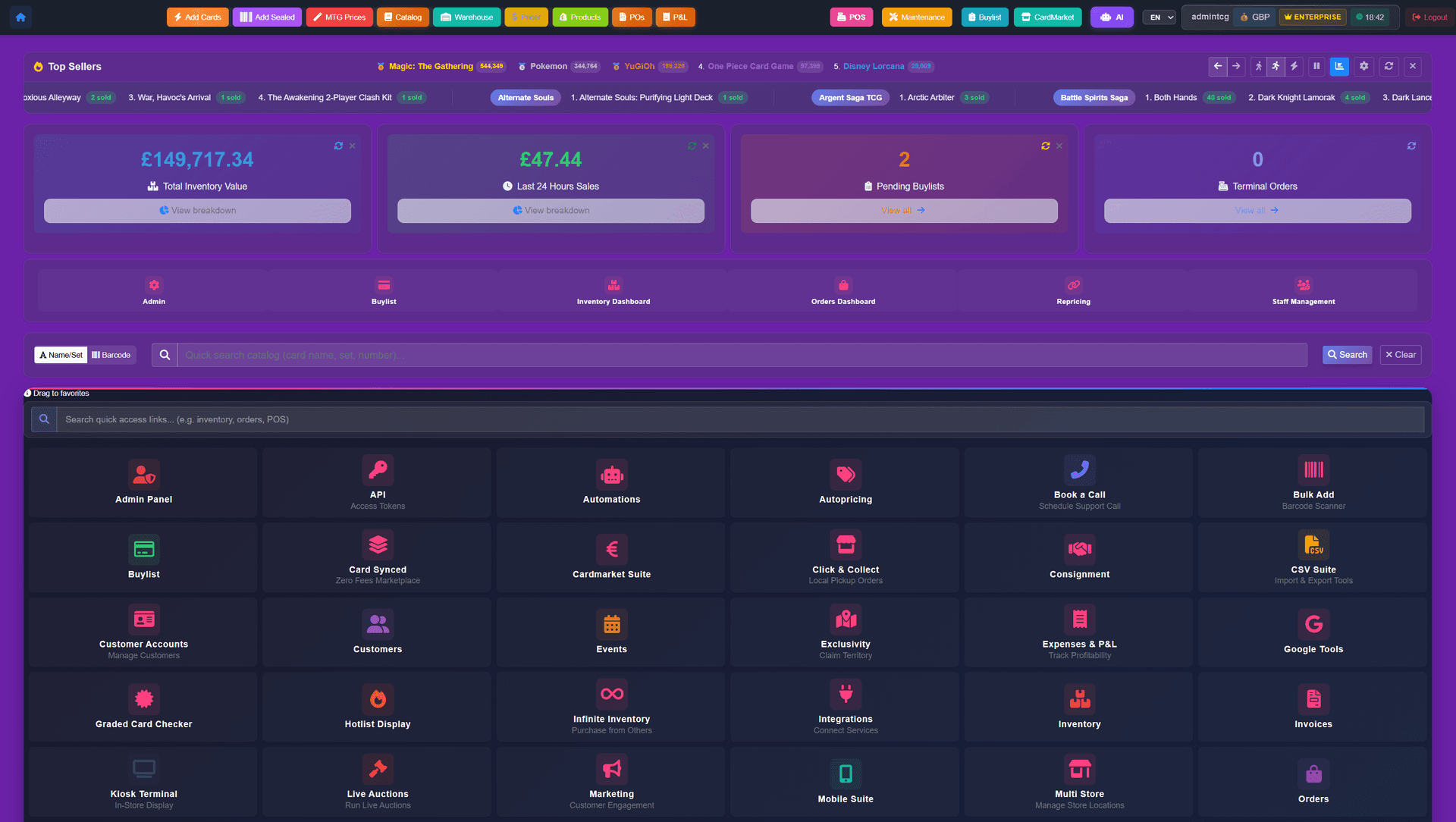
A generic store plus a dozen apps gets fragmented quickly. Card conditions, buylist, events, and marketplace sync all need first-class support, so compare a TCG-specific platform against the full cost of the app stack.
Friday Night Magic, Pokémon League, and casual Commander / Yu-Gi-Oh nights should be on the calendar from week one. Community builds on repetition. Announce the calendar before the doors open.
Price against TCGplayer market (not low) with autopricing. Set a floor. Exclude reserved-list and graded cards from autopricing. Reprice at least daily. Most new shops either overprice (no sales) or underprice (no margin) — both are avoidable.
Customers with cards to sell don't want to ship to TCGplayer Direct — they want cash today. A shop that offers buylist at the till from day one builds a singles inventory faster than any pure buying strategy.
TCGplayer, Cardmarket, and eBay aren't just competitors — they're sales channels. Listing your inventory there from month one is a free second revenue stream that pays the rent on slow weeks.
Singles turnover, repeat-customer rate, event attendance trend, and sealed gross margin are the four metrics that predict whether a shop is growing or quietly dying. Ignore vanity metrics (followers, pageviews) for the first year.
On TCG Sync, most new shops start with Storefront Pro: $1,000 USD setup plus 2% of TCG singles and sealed sales, with no monthly fee. With $150k USD of TCG singles and sealed sales in year one, that's $1,000 + $3,000 = $4,000 USD. Shopify is the online-shop system your product list lives in — we can set it up for you, and TCG Sync runs your till, buylist and website on top of it. Alongside that, you pay:
TCG Sync ships the storefront, POS, buylist, events, and marketplace sync in one platform. We train your staff over Zoom, and can book a call whenever you'd like to talk something through. Opening a new shop or selling under about $1.5M a year in TCG? Storefront Pro is usually the right place to start — same software, no monthly fee.
Starting from$2,499USD per month
No setup fee and no sales percentage
Discuss Enterprise$1,000USD one-time setup
+ 2% of TCG singles and sealed sales across POS, Shopify and marketplaces — comics, board games, accessories, drinks, toys and other non-TCG items are excluded
Start with Storefront ProLet’s discuss itScoped around your business
Scope and pricing agreed together
Let’s discuss itEmail us about your store and we'll take it from there.
Related topics, running on the same platform underneath.
WPN, Commander stock, FNM, and prerelease planning.
League, sealed allocation, and serving collectors and players at once.
OTS registration, Locals, and repricing fast enough to keep up.
The four numbers that predict whether a shop survives year two.